
Say Vivaldi and most people will think of The Four Seasons and the virtuosic violin playing it entails.
Read on to find out more about this hugely popular work by one of the best-known Italian composers of all time.
Featured in concert at Huddersfield Town Hall on Sunday 14 June with the Leader of the Orchestra of Opera North, Katie Stillman
Book now
What’s the music like?
Orchestra Leader Katie Stillman who will be directing the concert, shares what to expect:
“Vivaldi’s The Four Seasons are some of the earliest examples of programme music (music designed with a narrative) with Vivaldi bringing to life different aspects of the season with poetry and music, using the three movements of each concerto to describe the scene. Due to this storytelling nature, the music stays completely fresh; I find that no two performances are ever the same. My imagination creates a new world for every performance.
“In Spring, we have birds tweeting and a beautiful depiction of a babbling brook, followed by an early Spring thunderstorm. The sleeping goatherd in the meadow is looked over by the dog (depicted by the solo viola) in the 2nd movement, and we round off the season with a pastoral dance. Summer starts with a lazy and hazy feeling before the cuckoos wake up! The slow movement is again dominated by the feeling of heat – and some extremely irritating mosquitos. The big storm of the 3rd movement doesn’t let up until the final note. I always need a breather after Summer before we turn to Autumn!
“As we get nearer to the end of the year, Vivaldi introduces a heaviness in the sound – a feeling of stomping in bigger boots. Horn calls and a moment of tranquillity in the 2nd movement contrast with some drunken lurching. After that, Winter arrives with icy sounds passing around the orchestra: boots breaking the ice and wild beasts fleeing in the forests. The 2nd movement takes us indoors next to the fire with some melting water dripping outside, while the final movement takes us back to the delicious chill of those frosty landscapes.”
Listen to the music
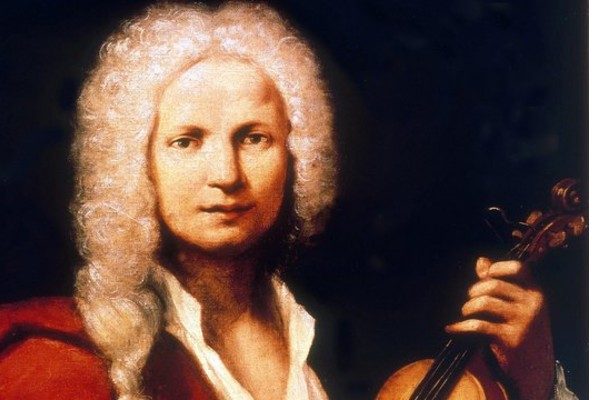
Antonio Vivaldi who composed The Four Seasons
Who was the composer?
Antonio Vivaldi was born in Venice on 4 March 1678. During his lifetime, he became one of the Baroque eras most influential composers, particularly for the solo violin, and yet ultimately he died in penury following a life fighting against ill-health.
His main teacher during his early years was almost certainly his father, Giovanni Battista, who had become a professional violinist after starting his working life as a barber. It probably came as no surprise when the violin also became his son’s chosen instrument – in fact, almost half the concerti Vivaldi subsequently wrote were for that instrument. Around 1718, he moved to Mantua at the behest of Prince Philip of Hesse-Darmstadt who offered him the post of ‘maestro di cappella’ (Master of the Chapel). This period marked a turning point in his life when his musical career really took off. Throughout his lifetime, Vivaldi travelled widely throughout Europe, most often accompanied by his pupil and assistant Anna Girò and her half-sister, Paolina, promoting his work and cementing his reputation.
Despite his talent and commitment to his art, Vivaldi made a potentially fatal error when he made the decision to move to Vienna to seek the favour of Emperor Charles VI who admired his music. Unfortunately, the monarch died shortly after his arrival. With his money spent, musical tastes changing and his dreams in tatters, Vivaldi died a pauper in the city on 28 July 1741.

Katie Stillman who will be leading The Four Seasons. Photography by Justin Slee
When was The Four Seasons written?
It is thought that Vivaldi was inspired by the countryside around him when he wrote The Four Seasons during his time in Mantua. The exact date of composition is unknown, although it is widely believed to have been between 1720 and 1723. The work premiered in Amsterdam in 1725.
The Four Seasons actually formed part of a larger collection of 12 concertos which were published under the title, Il Cimento dell’ Armonia e dell’ Inventione (The Contest between Harmony and Invention). What made the work so striking and unusual at the time was Vivaldi decision to use music as a way of telling a story, with his composition providing the musical illustration for a set of Italian sonnets which he probably wrote himself. With the solo virtuosic passages for the violin, it has become one of the most well-known pieces for his favoured instrument and a much-loved member of the musical cannon despite the somewhat mixed response when it was first peformed.

The piece demands some virtuosic violin playing. Photography by Justin Slee
Did you know?
— Vivaldi was ordained as a priest but subsequently found himself unable to conduct mass due to his bronchial asthma.
— He was given the nickname ‘Il Prete Rosso’ or The Red Priest referencing both his ordination and his red hair.
— The composer wrote many pieces for the all-female orchestra at Ospedale della Pietà, a home for abandoned children in Venice.
The Orchestra of Opera North perform The Four Seasons with Leader Katie Stillman at Huddersfield Town Hall as part of the Kirklees Concert Season at 4pm on Sunday 14 June. The programme also features repertoire by Mozart and Ravel.
Book now

